

How to Play FreeCell: The Rules Explained, Plus Deal #1 Solved Move by Move (54 Moves)
New to FreeCell and not sure where to start? Learn the free cells, foundations and eight columns from one picture, then follow the first nine moves of classic deal #1 with an explanation for each, plus the full 54-move solution. Every move was played in this site's game.
Play FreeCell online
In one sentence: FreeCell is the solitaire you can almost always win. All 52 cards are dealt face up, so the result depends on how you shuffle cards around, not on luck. This guide explains the rules with one picture, then walks you through classic deal #1 from start to finish. In FreeCell online, type 1 into Deal # and click Go to deal: you will see exactly the same layout as in this guide and can follow it all the way to the win.
The deal #1 solution here was found by a program using this site's own FreeCell rules and then played card by card in the game: all 54 moves bring every card home (once with a mouse, once by touch on a phone).
The table: three areas
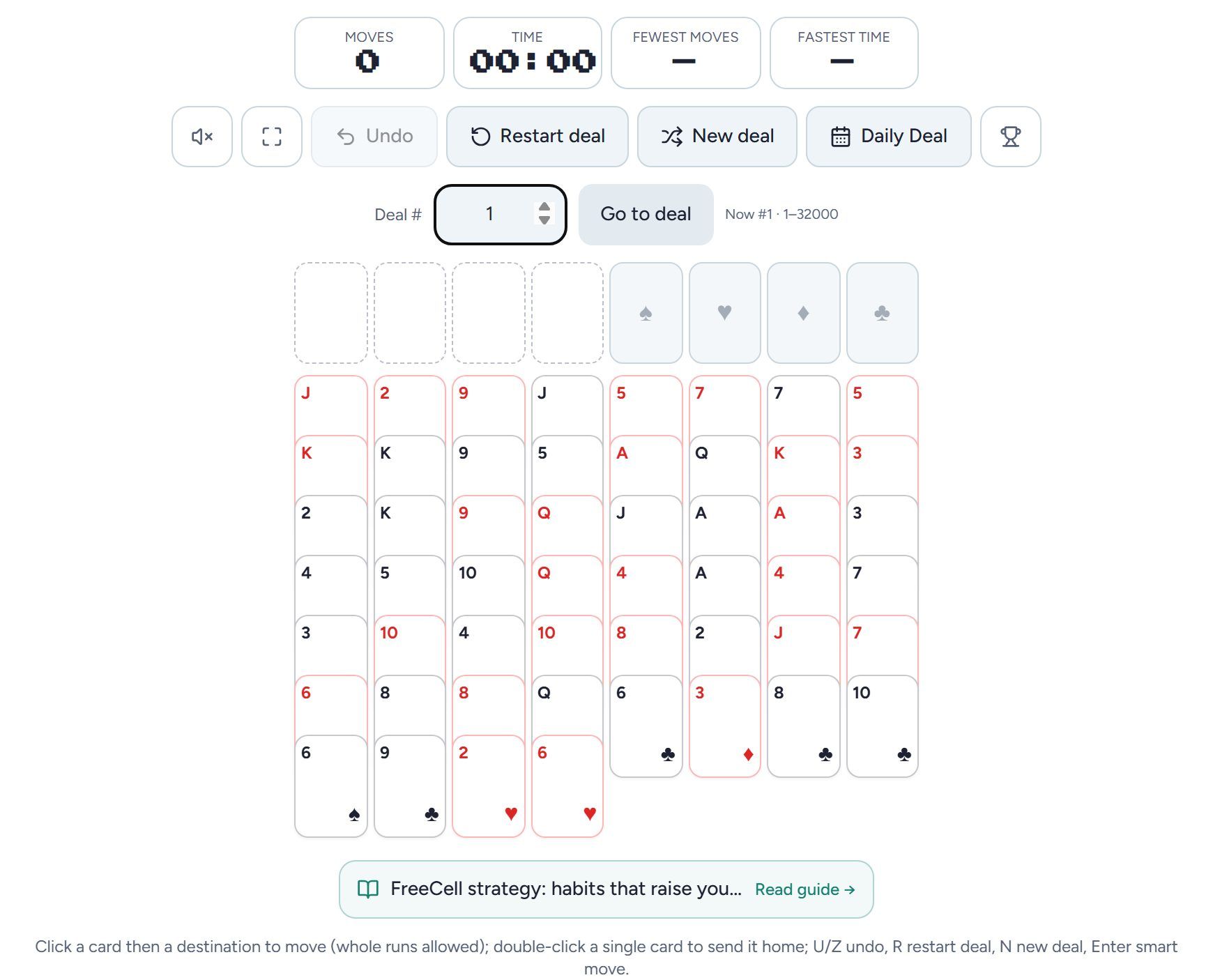
- Four free cells (top left): each holds one card of any kind, as temporary storage.
- Four foundations (top right): one pile per suit, built from Ace up to King. Fill all four and you have won.
- Eight columns (below): all 52 cards start here, seven cards in each of the first four columns and six in each of the other four. Only the bottom card of each column (the one nearest you) can be picked up directly.
Only three rules
- In the columns, build down in alternating colours. A black 8 only takes a red 7 (♥7 or ♦7).
- One card per free cell. A card in a free cell can later go back onto a column or up to a foundation.
- An empty column takes any card (or a correctly built run of cards).
Unlike Klondike, the classic Windows Solitaire, FreeCell has no stock pile and no face-down cards. You can see every card from the first move, so in principle you can plan the whole game.
How many cards can you move at once? Remember this formula
Strictly speaking, FreeCell moves one card at a time, but the game lets you move a whole run (alternating colours, consecutive ranks) in one go, as long as there is enough free space to do it card by card:
Maximum cards per move = (empty free cells + 1) × 2^(empty columns)
| Empty free cells | Empty columns | Max cards per move |
|---|---|---|
| 0 | 0 | 1 |
| 1 | 0 | 2 |
| 2 | 0 | 3 |
| 2 | 1 | 6 |
| 4 | 0 | 5 |
That is why experienced players say an empty column is worth more than a free cell: each empty column doubles how far you can move a run.
Controls on this site
- Click the card, then the destination: click the card you want to move (clicking the top card of a run selects the whole run), then click any card in the target column, an empty column, a free cell or a foundation.
- Double-click a single card to send it straight to its foundation.
- Auto-play: Aces and Twos fly home automatically. Higher cards only go up on their own once both foundations of the opposite colour hold the card below them, so the game never takes a low card you might still need for building.
- Unlimited undo: U or Z to undo, R to restart the same deal, N for a new deal.
Walkthrough: the first nine moves of deal #1
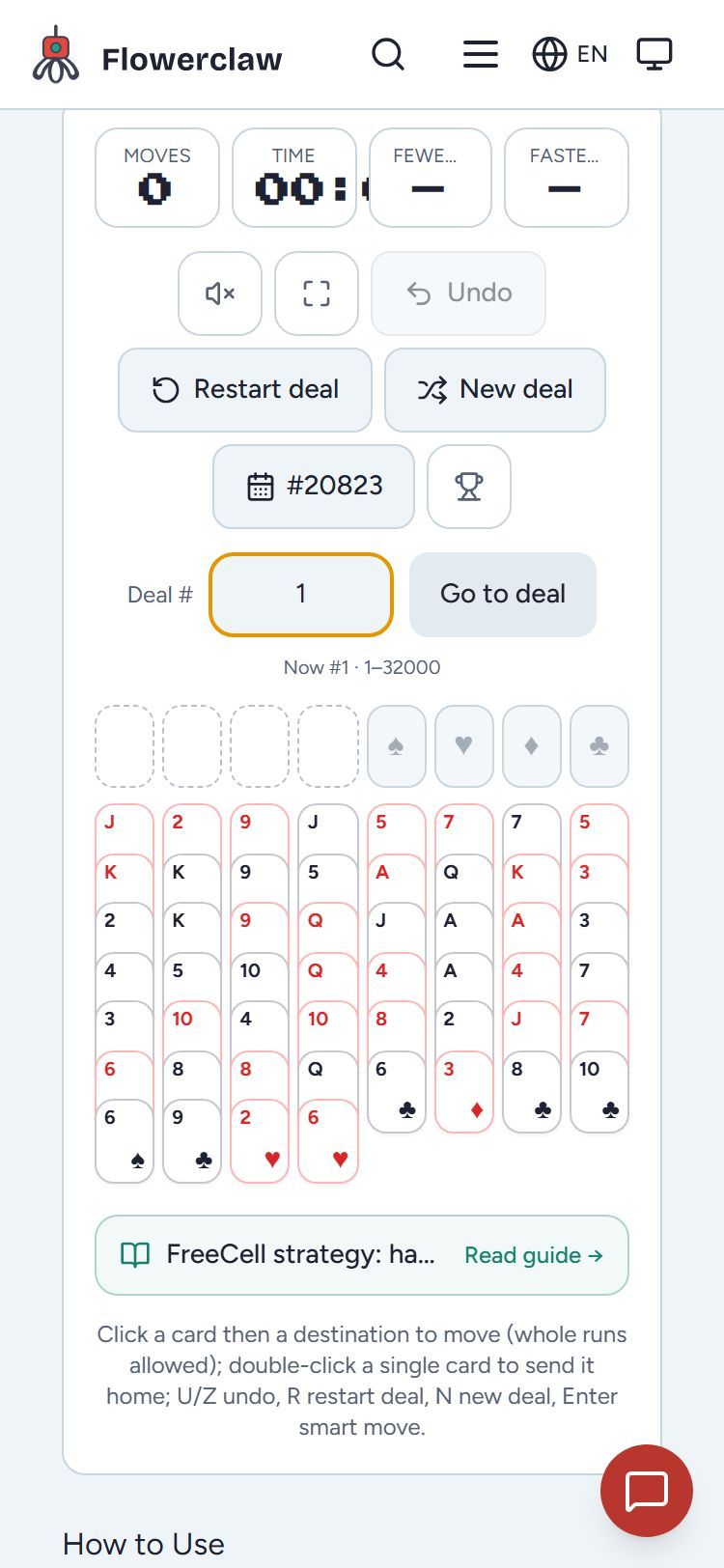
Enter 1 in Deal #. Reading each column from top to bottom, the layout is:
- Column 1: ♦J ♦K ♠2 ♣4 ♠3 ♦6 ♠6
- Column 2: ♦2 ♣K ♠K ♣5 ♦10 ♠8 ♣9
- Column 3: ♥9 ♠9 ♦9 ♠10 ♠4 ♦8 ♥2
- Column 4: ♣J ♠5 ♦Q ♥Q ♥10 ♠Q ♥6
- Column 5: ♦5 ♦A ♠J ♥4 ♥8 ♣6
- Column 6: ♥7 ♣Q ♠A ♣A ♣2 ♦3
- Column 7: ♣7 ♥K ♥A ♦4 ♥J ♣8
- Column 8: ♥5 ♥3 ♣3 ♠7 ♦7 ♣10
Before touching anything, scan the layout and ask: where are the four Aces? ♠A and ♣A are buried under ♣2 and ♦3 in column 6, ♥A sits in the middle of column 7, and ♦A is deep in column 5. The opening plan is simple: dig out the Aces while using as few free cells as possible.
| # | Move | Why |
|---|---|---|
| 1 | ♣10: column 8 → free cell | Column 8 hides ♣3 and ♥3, so take the ♣10 off the bottom to start digging for low cards. |
| 2 | ♦3: column 6 → free cell | Only the ♦3 stands between you and three low cards in column 6: ♣2, ♣A and ♠A. |
| 3 | ♣2: column 6 → free cell | ♣A is uncovered and goes home automatically, followed by the ♣2 from the free cell and the ♠A from the column. Three cards home in one move, and a free cell back. |
| 4 | ♣8: column 7 → free cell | ♥A is buried in column 7, so move the ♣8 off it first. |
| 5 | ♥J: column 7 → column 6 | The red Jack goes onto the black Queen in column 6 without using a free cell. |
| 6 | ♦4: column 7 → free cell | ♥A is uncovered and goes home, and the ♥2 at the bottom of column 3 follows it. The price: all four free cells are full for a moment. This is the tightest point of the opening, so the next two moves must give a cell back straight away. |
| 7 | ♦8: column 3 → column 2 | Red 8 onto black 9, which uncovers the ♠4 in column 3. |
| 8 | ♦3: free cell → column 3 | Red 3 onto black 4, returning the free cell borrowed in move 2. |
| 9 | ♣Q-♥J (2 cards): column 6 → column 7 | The run goes onto the ♥K. With one empty free cell the formula allows 2 cards, exactly enough. |
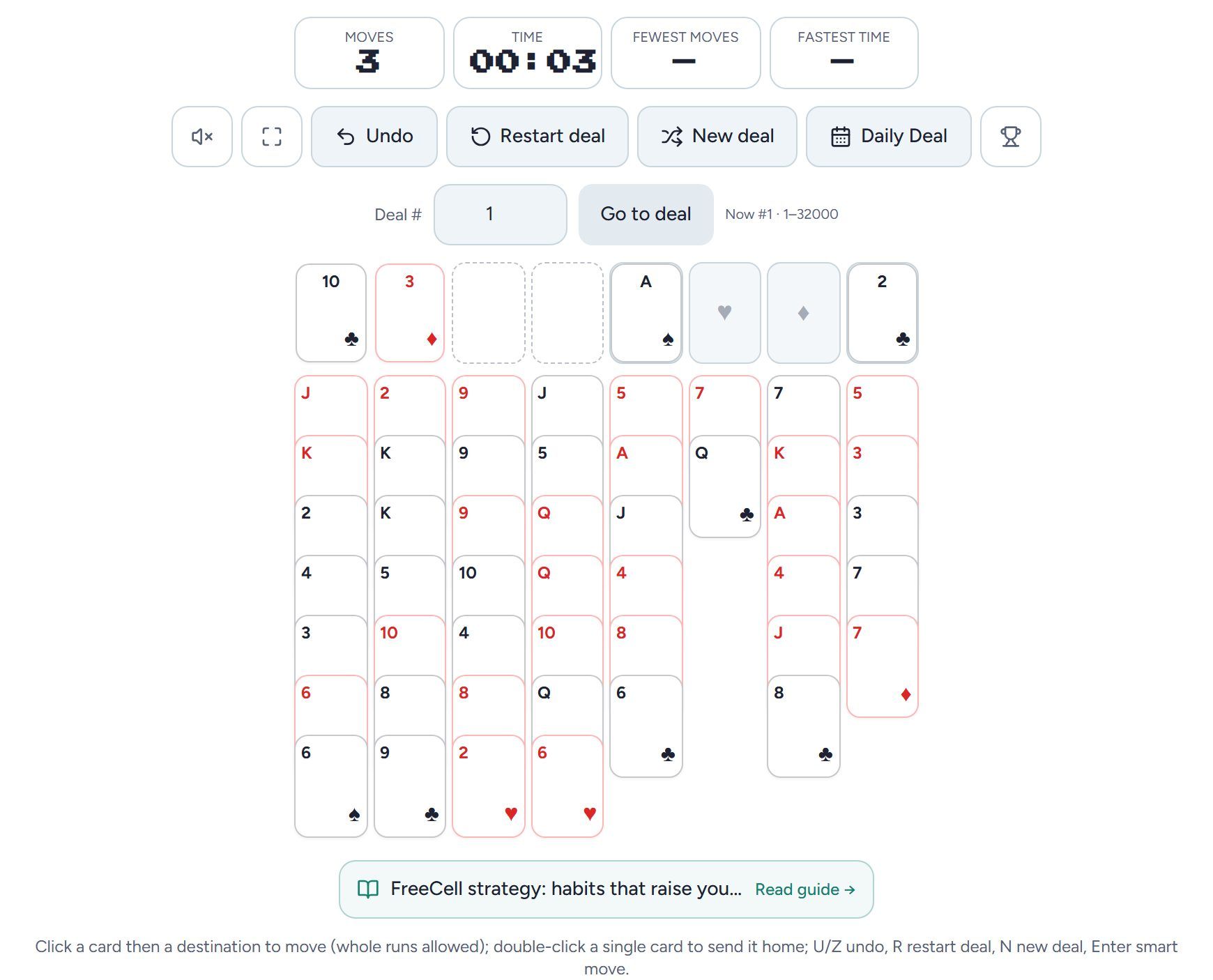
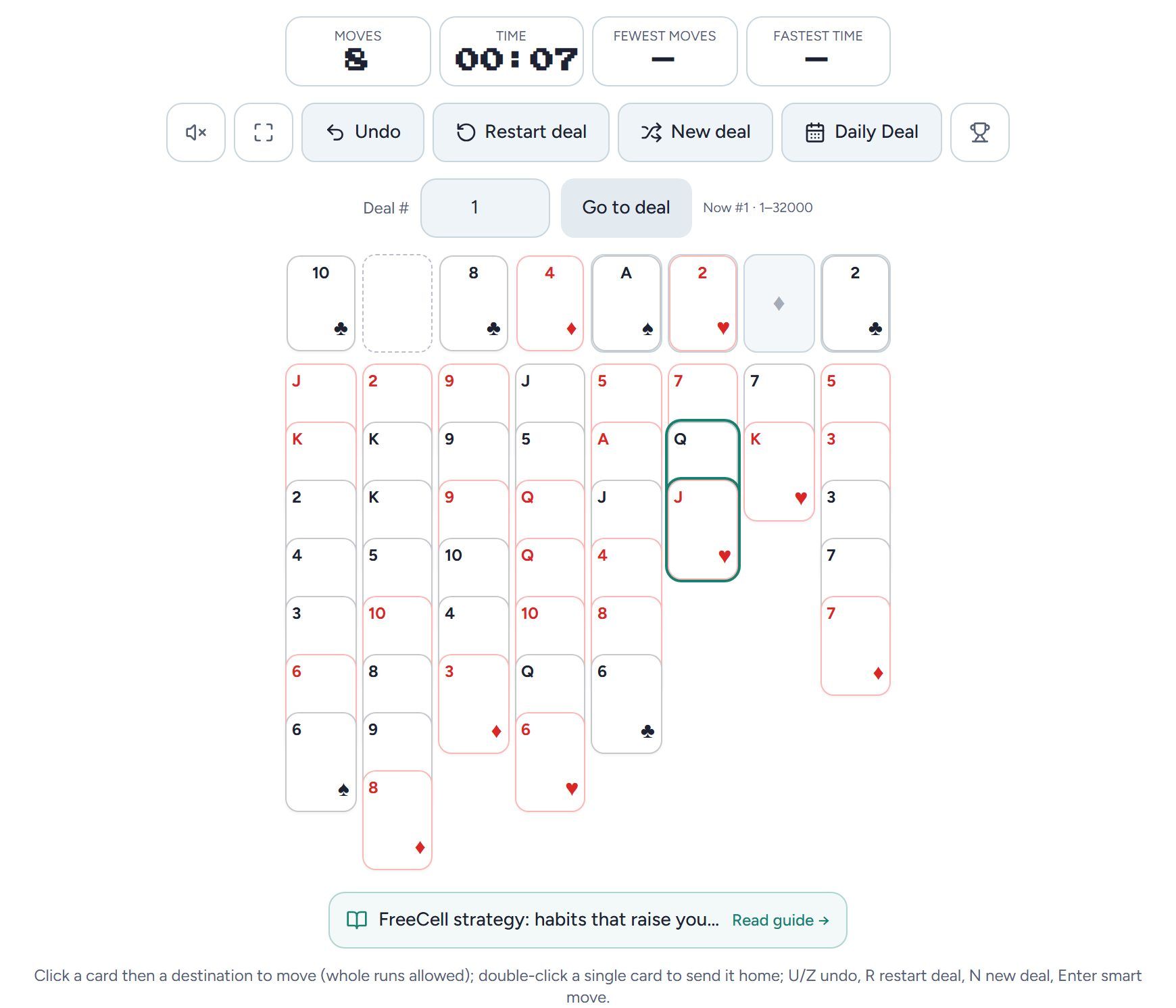
At this point ♠A, ♣A, ♣2, ♥A and ♥2 are home and the free cells have gone from all four full back down to three in use. The opening is under control.
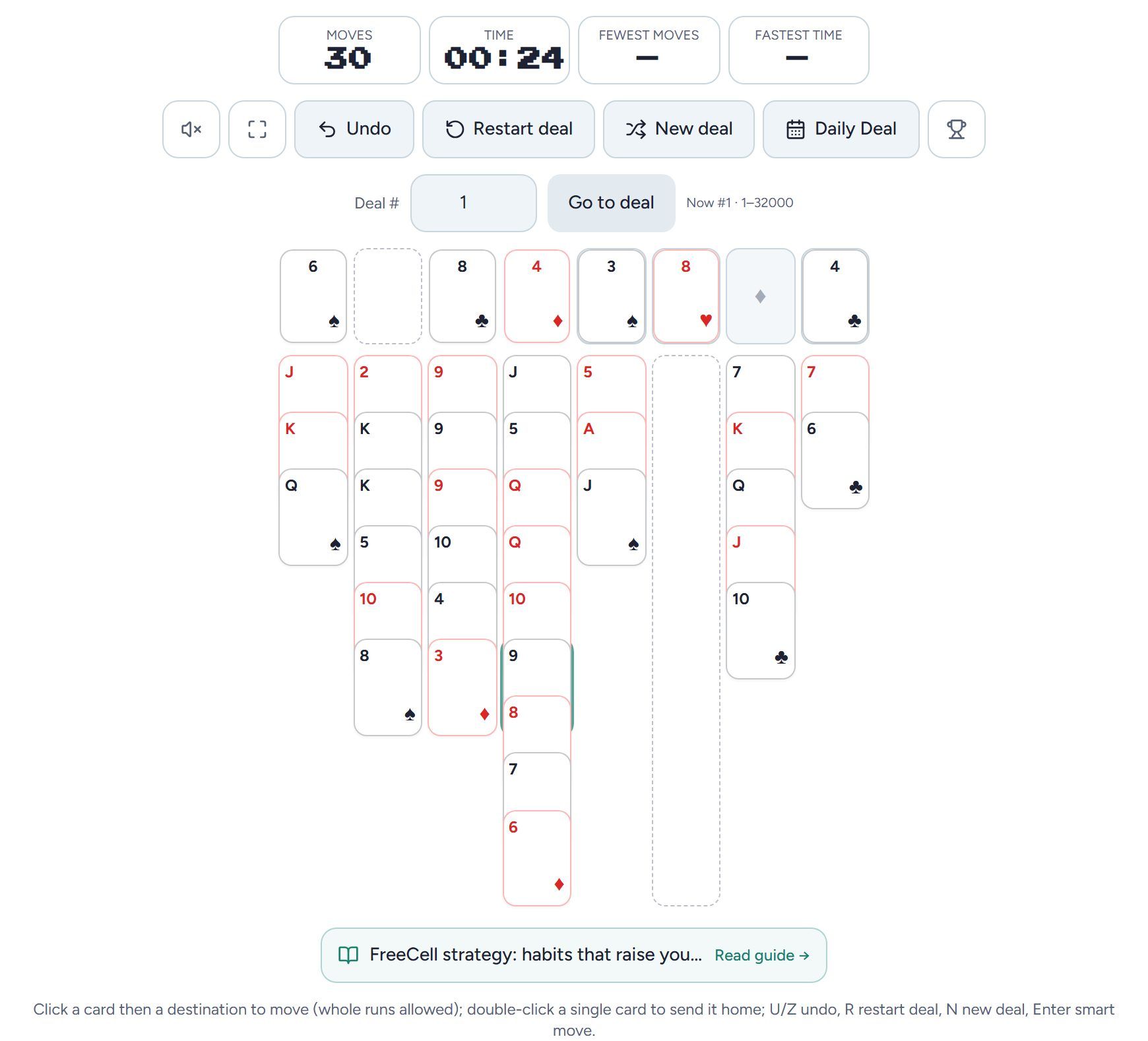
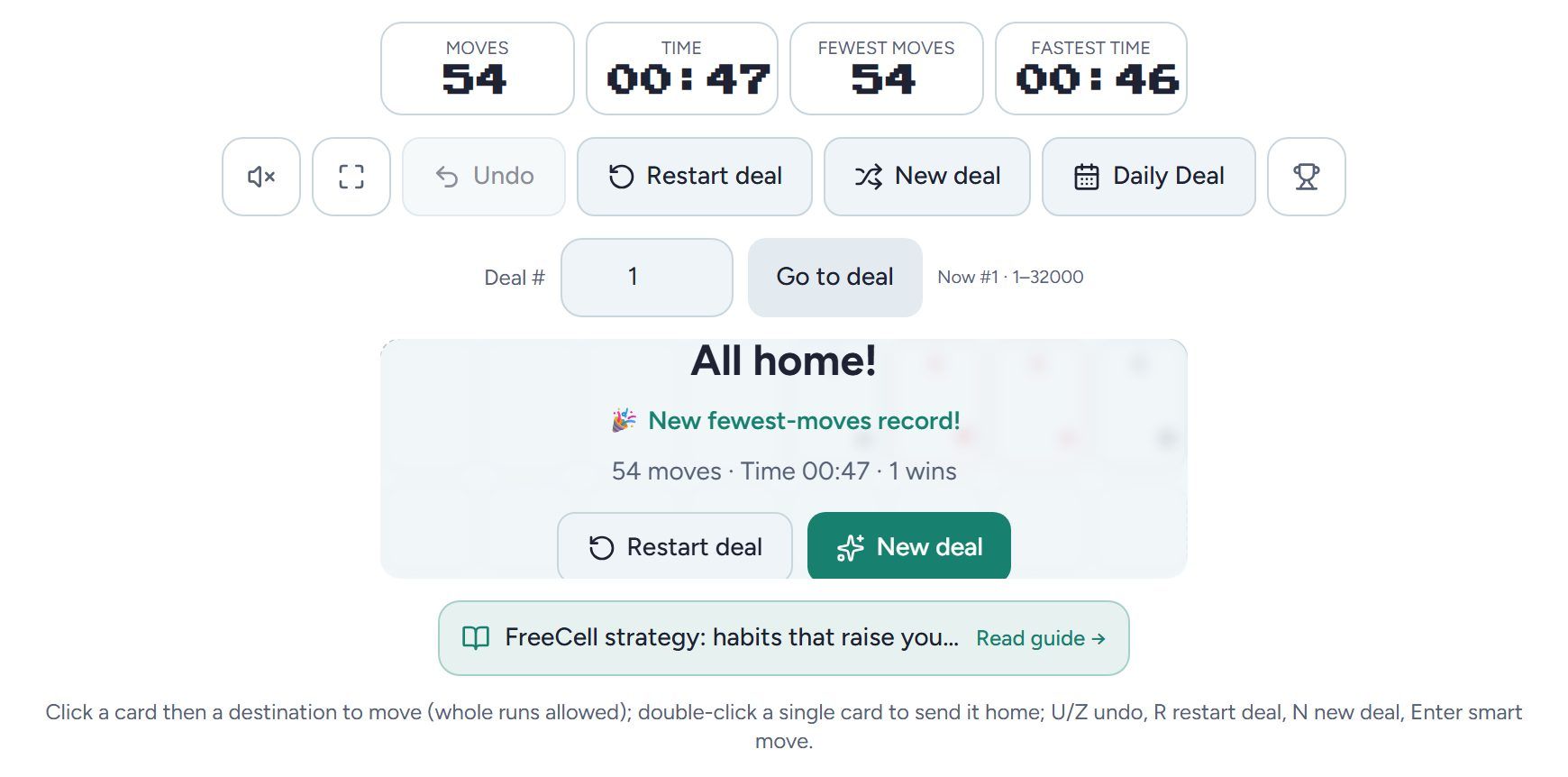
The remaining moves are not explained one by one; the full 54-move solution is in the table at the end. Played exactly as listed, the last move sets off a chain of automatic moves to the foundations and the game is won:
It plays just as well on a phone: tap a card, tap where it goes, and double-tap a single card to send it home.
Five beginner mistakes
- Filling every free cell straight away. With all four full you can only move one card at a time, and you will soon be stuck. Try to keep at least one free cell open.
- Dropping a single card into an empty column. An empty column doubles how many cards you can move, so only fill it when that uncovers a card you really need.
- Rushing cards to the foundations. Send low cards home too fast and you will run out of cards to build on. Aces and Twos are always safe; from Threes up, think first.
- Moving a long run without counting. Check the formula before you start. If there isn't enough space, make room first, or the run will end up split.
- Restarting as soon as you are stuck. Undo is unlimited here. Going back a few moves and trying another route often saves the game.
Where to go next
Once the rules feel familiar, read FreeCell Strategy: Practical Tips to Win More Games to learn how to plan long runs and when to empty a column. You can also try two other solitaire games: Solitaire (Klondike) and Spider Solitaire.
FAQ
Can every FreeCell game be won? Almost. Of the classic deals numbered 1 to 32000, only deal #11982 has been shown to be unsolvable.
Are the deal numbers the same as in Windows FreeCell? Yes. This site generates deals 1 to 32000 with Microsoft's classic dealing algorithm, so deal #1 here has exactly the same layout as deal #1 in Windows FreeCell.
Do I have to use 54 moves? No. This is just one solution, and fewer moves is better. The game keeps track of your fewest moves and fastest time for each deal.
Appendix: the full 54-move solution to deal #1
The "Auto-played" column lists the cards the game sends to the foundations automatically after that move.
| # | Move | Auto-played |
|---|---|---|
| 1 | ♣10: column 8 → free cell 1 | |
| 2 | ♦3: column 6 → free cell 2 | |
| 3 | ♣2: column 6 → free cell 3 | ♣A ♣2 ♠A |
| 4 | ♣8: column 7 → free cell 3 | |
| 5 | ♥J: column 7 → column 6 | |
| 6 | ♦4: column 7 → free cell 4 | ♥A ♥2 |
| 7 | ♦8: column 3 → column 2 | |
| 8 | ♦3: free cell 2 → column 3 | |
| 9 | ♣Q-♥J: column 6 → column 7 | |
| 10 | ♦7: column 8 → free cell 2 | |
| 11 | ♠7: column 8 → column 2 | |
| 12 | ♣3: column 8 → foundation | |
| 13 | ♥3: column 8 → foundation | |
| 14 | ♠6: column 1 → column 6 | |
| 15 | ♦6: column 1 → column 2 | |
| 16 | ♥5: column 8 → column 5 | |
| 17 | ♠3: column 1 → column 8 | |
| 18 | ♣4: column 1 → foundation | ♠2 |
| 19 | ♠3: column 8 → foundation | |
| 20 | ♦7: free cell 2 → column 8 | |
| 21 | ♣6-♥5: column 5 → column 8 | |
| 22 | ♥8: column 5 → free cell 2 | ♥4 |
| 23 | ♥5: column 8 → foundation | |
| 24 | ♥6: column 4 → foundation | |
| 25 | ♣10: free cell 1 → column 7 | |
| 26 | ♠6: column 6 → free cell 1 | |
| 27 | ♥7: column 6 → foundation | |
| 28 | ♥8: free cell 2 → foundation | |
| 29 | ♠Q: column 4 → column 1 | |
| 30 | ♣9-♦8-♠7-♦6: column 2 → column 4 | |
| 31 | ♠J: column 5 → column 6 | ♦A |
| 32 | ♠4-♦3: column 3 → column 5 | |
| 33 | ♠10: column 3 → free cell 2 | |
| 34 | ♠8: column 2 → column 3 | |
| 35 | ♦10: column 2 → column 6 | |
| 36 | ♣5: column 2 → foundation | |
| 37 | ♣6: column 8 → foundation | |
| 38 | ♦7: column 8 → column 3 | |
| 39 | ♠6: free cell 1 → column 3 | |
| 40 | ♥K-♣Q-♥J-♣10: column 7 → column 8 | |
| 41 | ♣7: column 7 → foundation | |
| 42 | ♣8: free cell 3 → foundation | |
| 43 | ♠K: column 2 → free cell 1 | |
| 44 | ♣K: column 2 → free cell 3 | ♦2 ♦3 ♦4 ♠4 ♦5 |
| 45 | ♦6: column 4 → foundation | |
| 46 | ♦9-♠8-♦7-♠6: column 3 → column 8 | |
| 47 | ♠9: column 3 → column 6 | |
| 48 | ♥9: column 3 → foundation | |
| 49 | ♦8-♠7: column 4 → column 6 | |
| 50 | ♣9: column 4 → foundation | |
| 51 | ♥10: column 4 → foundation | |
| 52 | ♥Q: column 4 → free cell 4 | |
| 53 | ♦Q: column 4 → column 2 | ♠5 ♠6 ♠7 ♦7 ♦8 ♠8 ♠9 ♦9 ♠10 ♦10 ♠J ♣10 ♣J ♥J ♥Q |
| 54 | ♦K-♠Q: column 1 → column 3 | ♦J ♦Q ♠Q ♠K ♣Q ♣K ♦K ♥K |
Try it now: open FreeCell, type 1 into Deal # and play the nine opening moves above.