OpenAI Is Filling Data Centers With Mac Minis: A Misunderstood Shift in AI Compute
While the world watches the Nvidia H100 arms race, OpenAI is quietly deploying tens of thousands of consumer-grade Apple chips into its server rooms. This isn't about saving money — it signals a quiet divergence in how AI models are trained.
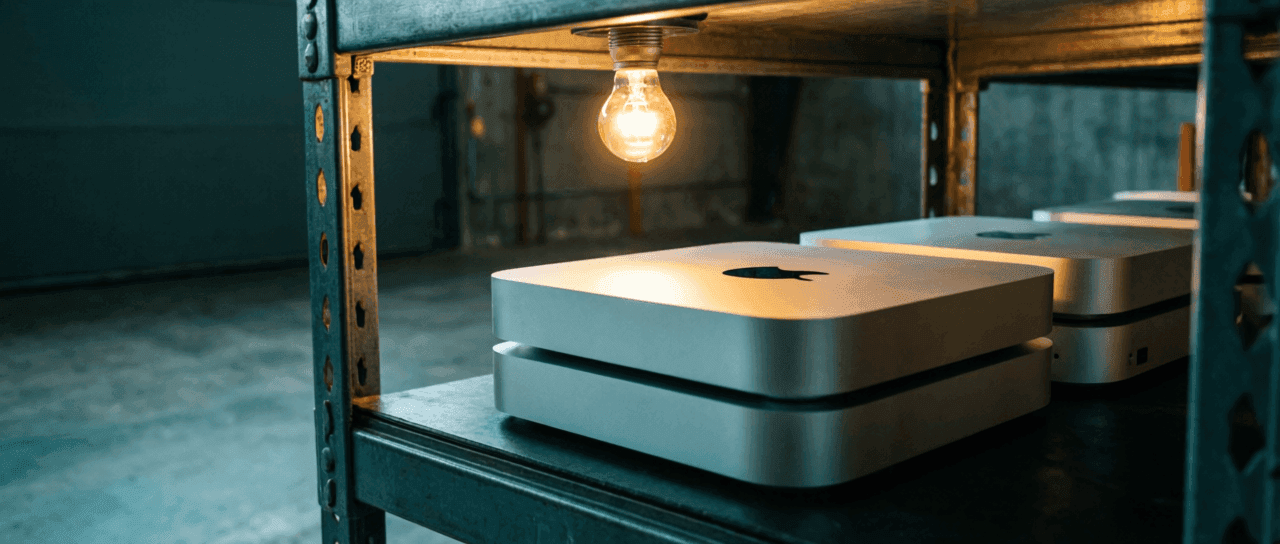
The tech world recently buzzed with a counterintuitive report: OpenAI is purchasing tens of thousands of Mac Minis — not to sit on employees' desks for coding, but to be racked in data centers for AI training.
The instinctive reaction might be to assume Sam Altman and Jensen Huang had a falling out. But placed in the context of AI training's technical evolution, this move points to a deeper fracture: the word "training" is being split into two fundamentally different tasks, each with diverging hardware requirements.
Pre-Training and Post-Training Are Fundamentally Different Jobs
To understand why OpenAI is buying Macs, you first need to understand the two phases of modern AI training.
Pre-training is where a model "reads the entire internet," learning language, logic, and world knowledge. It is characterized by massive matrix operations and enormous data throughput, demanding extreme single-GPU compute power and memory bandwidth. Nvidia's high-end GPUs dominate this space because they were purpose-built for brute-force computation.
Post-training, particularly reinforcement learning (RL), follows an entirely different logic. Instead of making the model "read books," it makes the model "take exams" — repeatedly trial-and-erroring in simulated environments, receiving feedback, and adjusting strategies. To use an analogy: pre-training is like having a student devour an entire library; post-training is like having that student sit through tens of thousands of mock exams.
What does post-training demand from hardware? Not raw single-chip power, but high inference throughput, low latency, and massively parallel environments. You need to run thousands of simulated scenarios simultaneously, letting AI agents make decisions, score points, and refine strategies. This workload is fundamentally closer to large-scale inference than to large-scale training.
This is the logical entry point for the Mac Mini.

Unified Memory: An Overlooked Architectural Advantage
The Mac Mini runs on Apple Silicon (the M-series chips), which features an architecture that is particularly well-suited to AI inference: Unified Memory Architecture (UMA).
In a traditional GPU setup, video memory (VRAM) and system memory are separate, requiring data to be shuttled back and forth between them. Apple Silicon merges the CPU and GPU memory pools, so data is shared directly without any copying.
Think of it like two kitchens. In one, the fridge and the stove are in separate rooms, so the chef has to run back and forth. In the other, the fridge is right next to the stove. Cooking speed may not be faster, but all the time spent running between rooms is saved.
For the massively parallel inference tasks in reinforcement learning, this architecture can offer a better cost-performance ratio than stacking high-end GPUs. A single Mac Mini draws far less power than one H100 GPU, and when you run tens of thousands of them in parallel for inference, the differences in electricity, cooling, and rack space add up to a massive cost gap.
The core logic behind OpenAI's purchase is not "Macs are more powerful than GPUs." It is that for this specific workload, the cost-performance curve of Macs and the cost-performance curve of GPUs have crossed. This is an actuarial calculation, not an impulse buy.
Nvidia's Moat Hasn't Dried Up — But the River Is Branching
A reality check is in order: this does not mean Nvidia has been displaced in AI training.
Pre-training remains Nvidia's undisputed home turf. When you need to coordinate tens of thousands of GPUs in a cluster for distributed training, the combined hardware-software moat of the CUDA ecosystem, NVLink interconnects, and the NCCL communication library currently has no viable alternative.
However, AI compute demand is shifting from a monolithic block to a layered, segmented structure. Pre-training uses high-end GPUs; post-training explores diverse hardware; inference is even beginning to use custom ASICs (Application-Specific Integrated Circuits). This divergence in workloads means Nvidia's "domain of dominance" is narrowing, even though its "depth of dominance" remains unmatched.
In other words, the AI hardware market is moving from "winner takes all" to "each to their station." Nvidia has held the most valuable high ground, but different crops are starting to grow on the surrounding plains.
There is a historical parallel. When cloud computing first rose to prominence, everyone assumed x86 servers would rule the world. Instead, ARM architecture quietly captured half the mobile market. Not because ARM was stronger than x86, but because its power efficiency was a better fit for that specific scenario. Today's divergence in AI hardware may be the same script playing out again.

Custom Chips + Mac Purchases: A Two-Track Compute Strategy
At the same time, OpenAI is accelerating a parallel track: designing its own chips.
According to reports, OpenAI is advancing a custom chip project codenamed "Jalapeno" and plans to showcase its performance at the Hot Chips 2026 conference. Notably, the design cycle for this chip is only nine months — far shorter than the industry norm of two to three years. This likely involves heavy reliance on existing IP cores and advanced packaging strategies, but it also signals that OpenAI's commitment to compute independence is more than just talk.
Viewed together — custom chips and Mac Mini purchases — OpenAI's compute strategy becomes clear: break through the performance ceiling with custom silicon for high-end training, and drive down costs with diverse hardware for post-training and inference. Two tracks: one chasing the performance ceiling, the other pushing down the cost floor.
This mirrors Google's playbook of buying Nvidia GPUs while simultaneously developing its own TPUs (Tensor Processing Units). The difference is that Google deployed its custom chips at scale only after they proved successful, whereas OpenAI appears to want to use readily available consumer hardware to slash post-training costs before its custom silicon is ready.
In essence, this is a strategy of trading time for space: custom chips need time to mature, but the AI race waits for no one. Get post-training running on Mac Minis now, and gradually swap in custom chips once they are mature — keeping progress on track while controlling costs.
The Subtle Tension Between Apple and OpenAI
Around the same time these procurement reports surfaced, Apple reportedly sued OpenAI and two former Apple employees, Tang Tan and Chang Lui, alleging theft of hardware-related trade secrets. OpenAI has denied the allegations, attributing the dispute to Apple's own actions. The case is still in its early stages.
Without speculating on the specifics of the lawsuit, it reveals an interesting tension: OpenAI is simultaneously making large-scale purchases of Apple hardware for its core operations while clashing with Apple over talent and intellectual property. This "customer and competitor" dynamic is not uncommon in the tech industry, but it feels especially delicate in the current AI compute race.
Looking further ahead, if Apple ever decides to push deeper into the AI training hardware market — say, by launching Apple Silicon servers aimed at data centers — its relationship with OpenAI could evolve from "supplier and customer" into a more complex mix of competition and cooperation. This remains a speculative scenario, but one worth watching.
What This Means for Everyone Else
If you are not an AI practitioner, the significance of this news is not about whether to "buy a Mac or a graphics card." It lies in the trend it reveals: AI is shifting from "one way of training" to "multiple ways of training," and each method is searching for the hardware that suits it best.
This means future AI models could become cheaper — because the cost of post-training is coming down. It also means AI agents (AI systems that can make autonomous decisions) may arrive sooner — because reinforcement learning efficiency is improving. And it means the consumer device on your desk may be closer to the core of AI production than you think.
Next time someone tells you "you must buy Nvidia to do AI," you can tell them: things are changing. At least in certain stages of the pipeline, a small silver box can now pull up a chair to the table.
Key Takeaway: AI training is splitting into two distinct jobs. Nvidia has locked down the expensive one, but the cheaper work is starting to run on Macs. The compute race is no longer about who has the most raw power — it is about who does the best math on cost.