From 'Power Manager' to 'Heat Dissipator': How SiC Shoulders the Power Supply for NEV and AI?
Silicon carbide (SiC) material, with its high voltage resistance, low loss, and high thermal conductivity, is transforming from a 'wild card' to a 'standard' in power electronics and thermal management. With wafer capacity expansion slowing down and demand from automotive, PV storage, charging piles, AI, etc., booming, where are the profit points in the supply chain under the supply-demand balance?
Hot Hook
When you charge your EV at a highway service area fast charger, or run AI training tasks in a data center, there is an 'invisible hero' working behind the scenes—silicon carbide (SiC). This semiconductor material can simultaneously act as a 'power manager' and 'heat dissipator' in a chip the size of a palm, reducing energy loss by over 70% and significantly lowering heat generation. Recently, the SiC industry has seen a rare situation where capacity expansion is slowing down while demand continues to surge. Under this supply-demand balance, a multi-billion-dollar track is approaching a critical turning point.
Core Facts
Since the fourth quarter of 2025, the pace of new SiC wafer capacity expansion has noticeably slowed, but the three major markets—automotive (especially 800V high-voltage platforms), photovoltaic storage, and charging piles—remain highly prosperous, driving rapid growth in demand for domestic SiC MOSFET devices. Meanwhile, emerging scenarios like consumer electronics fast charging and AI server power supplies are experiencing concentrated demand bursts, and coupled with the expectation of semiconductor price hikes, end-device manufacturers are increasing their stockpiles. Supply-demand balance is the most accurate description of the current industry landscape.
Plain Explanation of Changes
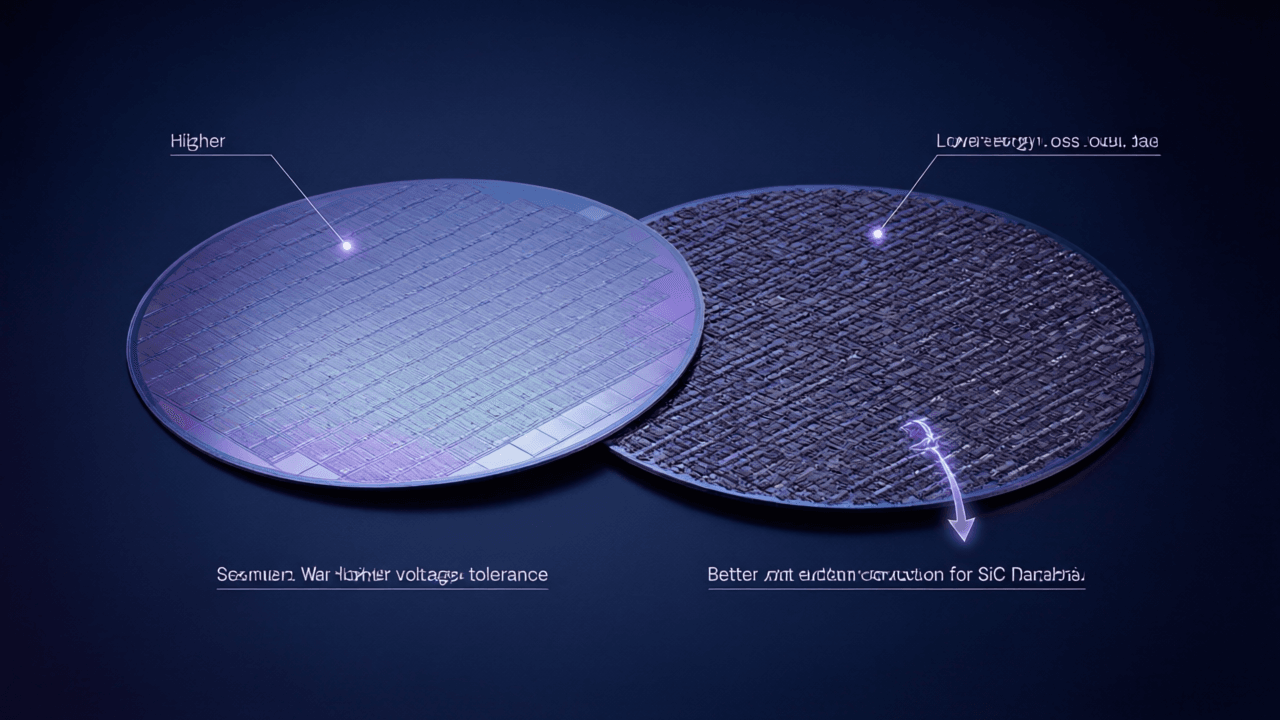
An analogy: If traditional silicon-based power devices are like ordinary water pipes, high water pressure (voltage) easily causes leaks (large energy loss, severe heating). SiC devices are like pipes made from special metal—they can withstand higher water pressure (high temperature and voltage), barely leak (extremely low on-resistance), and dissipate heat quickly (thermal conductivity three times that of silicon).
In the past few years, SiC wafer manufacturers expanded aggressively, but since Q4 2025, the pace of expansion has actively slowed—not because demand is weak, but because capacity digestion takes time. However, the downstream demand side is accelerating: new energy vehicles are shifting from 400V to 800V high-voltage platforms, making SiC MOSFET a standard component; photovoltaic inverters pursuing higher efficiency see SiC device penetration jump from 20% to 40%; and charging piles demand higher power density, making SiC the only choice.
Impact by Audience
- Working professionals (especially in manufacturing and energy): Benefiting from the localization of the SiC supply chain, related companies have strong demand for R&D and process engineers, with substantial salary increases. However, be aware of rapid technological iteration, requiring continuous learning.
- Students (electronics/materials/new energy majors): SiC is a frontier direction in wide-bandgap semiconductors; both thesis publication and job prospects are promising, but the entry barrier is high. Mastering device physics and packaging processes is recommended.
- Content creators (tech bloggers/reviewers): Topics covering SiC applications in NEVs, fast charging, and data centers have high traffic potential. Avoid exaggerated expressions like 'revolutionary disruption.'
- General consumers: In the short term, SiC will not directly change the price of phones or home appliances, but it will indirectly improve EV charging speed and reduce electricity bills (via grid efficiency gains). No need to specifically buy SiC-labeled products; wait for the industry to mature.
Neutral Pros & Cons + Pitfall Avoidance
| Dimension | SiC | Traditional Si |
|---|---|---|
| Voltage withstand | High (600V-1700V) | Low (mainly ≤600V) |
| Conduction loss | Extremely low | High (noticeable heating at same voltage) |
| Thermal conductivity | High (4.9 W/cm·K) | Low (1.5 W/cm·K) |
| Cost (per A current) | Currently 4-6x silicon | 1x (baseline) |
| Suitable applications | High voltage, high frequency, high temperature | Medium/low voltage, consumer electronics |
Advantages: SiC greatly improves system efficiency and reduces heat sink size—the core support for 800V EVs, photovoltaic inverters, and AI power supplies. Disadvantages: High defect density in substrates and low yields keep costs high; wafer capacity expansion is constrained by equipment supply, making substantial price drops unlikely in the near term. Pitfall avoidance: Beware of 'SiC concept stocks' that ride the trend without real technology; investment targets should focus on IDM companies that have passed automotive certification and are locked into leading customers.
Lightly Humanistic Elevation
The story of SiC is essentially about humanity's ultimate pursuit of efficiency—using less energy to do more. The shift from silicon to SiC changes not just the material, but our way of interacting with energy. Every technological leap is a redistribution of resources and wisdom.
Light Interactive Question
Would you consider a car with 800V+SiC when you next buy one? Or what are your thoughts on SiC applications in AI data centers? Feel free to share your opinions in the comments.